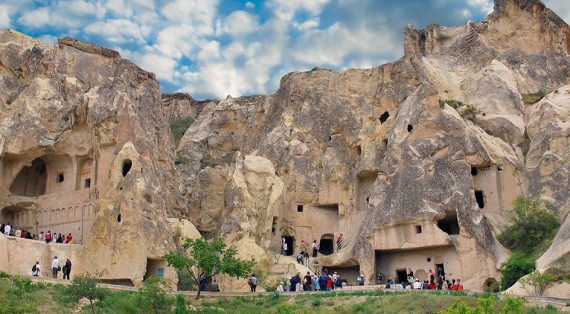
Cappadocia Open Air Museum
Let us explain to you little about the Cappadocia Open Air Museum, firstly in this article we will talk about the Cappadocia Open Air Museums such as Göreme Open Air Museum and Zelve Open Air Museum. In Cappadocia there are many things to discover but one of the most important things to see in here is the Cappadocia Open Air Museums. Why the Open Air Museum Cappadocia is so important? The thing is these places are old settlements of the early christians who lived in Cappadocia, for that reason where the early christians live they gave us many heritages such as Monasteries, Churches and Chapels which are full with frescos. Frescos are the unique wall paintings which shows us the scenes from The Holly Book Bible or Jesus Christ and Virgin Marry’s life, these frescos are painted for the people who don’t know how to read, in the monastery culture they always find a way to teach to people, even tough they don’t know how to read they can look at the paintings and have more information about the christian history.
Cappadocia is a treasure trove of history, filled with countless churches, underground cities, and other significant landmarks. Among these are the remarkable open-air museum Cappadocia, showcasing a blend of history, culture, and natural beauty. These museums, rich with chapels, monasteries, and churches carved into rock formations, are some of the most valued attractions in Cappadocia. When we say Cappadocia Open Air Museum first comes to mind is the rock-cut churches in Cappadocia Goreme open air museum.
Cappadocia Open Air Museum Göreme
Also known as Göreme Historical National Park, this place is in the UNESCO World Heritage list since 1985 was a vital center of education up until the 13th century. The museum owes its prominence to Saint Basil of Caesarea, who established a monastic lifestyle here in the 4th century AD. One of the first places in Anatolia where they start living the monastic life as a comunity. Saint Basil was the leader of that monastic life and the idea was living with the people and introducing the christian traditions and history more to the local folk of Cappadocia.
The rock-cut settlement includes chapels, dining halls, and living quarters, all intricately carved into soft volcanic tuff. The important part of these churches and chapels they are rock cut architectures. Rock-Cut Churches The museum is home to many chapels and churches, such as the Dark Church (Karanlık Kilise) and the Apple Church (Elmalı Kilise), adorned with well-preserved frescoes depicting biblical stories. Rock-cut architectures are very hard to do the desing in inside because once you skip to do something you cannot add after, for that reason as a architecture these things are remarkable planned before they carve it, you can easly tell by the perfectly carved Roman Columns inside the buildings.
Also Göreme Cappadocia Open Air Museum is not a place where everybody lives. Inside this small comunity only the religious people was staying at that side of the town, people who is giving the education as a priest or the teacher or the people who is getting the education in there was only able to stay there. Which gives them more strict life where they all suppose to be do all the daily things by following and practicing the religion of christianity at the same time in their Monastic Life. Visitors can also explore the remains of monastic complexes, including living quarters and dining halls. In the Cappadocia Göreme Open Air Museum there are two big building as Girls and Boys Monastery they are no longer open for visit for safety purposes but even from outside they are stunning.
Down bellow you can find a list of Göreme Cappadocia Open Air Museum churches:
- Chapel of St. Basil
- Chapel of St. Barbara
- Monastery of Nuns and Monks
- Dark Church (Karanlık Kilise)
- Tokalı Church
- Çarıklı Church
- Apple Church (Elmalı Kilise)
- Snake Church (Yılanlı Kilise)
These churches and chapels feature exquisite frescoes, including geometric motifs that reflect early Christian art.
Zelve Open Air Museum
While we are talking about the Cappadocia Open Air Museum we can’t miss the Zelve Open Air Museum because like Göreme Open air Museum, Zelve is also one of the first christian settlements in Cappadocica region. Why the Zelve Open Air Museum is different? unlike the Göreme Open Air Museum in Zelve there is also a Mosque inside the Zelve Cappadocia open air museum, and this is an important example to see various religions lived in Anatolia Cappadocia during the history. Zelve Open Air museum was a village until 1960’s and people were living inside the cave houses. The Zelve Open-Air Museum is a stunning complex housing numerous fairy chimneys and rock formations. Its historical value is amplified by the beautifully preserved rock-carved churches and monasteries within. The intricate craftsmanship seen on the walls of the homes and structures in Zelve is truly remarkable.
Zelve Open Air Museum is also known as the Zelve Valley, it’s located inside the Red Valley but Zelve itself is also located in a deep valley and there is a 4 km walking path in inside. Visiting every single part of the museum takes minimum 2 hours, it’s so big that even you have to take a break sometimes. Is also a really good place to do trekking in inside because the Zelve Valley is full with uphill and downhill routes. But Cappadocia Open Air Museum is always worth to see and worth the take a walk in inside.
Here the list of churches in zelve Cappadocia open air museum:
Balıklı Kilise (Church of the Fish)
Located in the third valley, this church is adorned with frescoes of the Virgin Mary holding baby Jesus, along with depictions of angels Michael and Gabriel. Estimated to date back to the 10th century, it remains an iconic part of Zelve’s rich history.
Üzümlü Kilise (Church of the Grapes)
This church also belongs to the monastery in the third valley, with detailed artwork and grape motifs symbolizing Eucharistic wine.
Geyikli Kilise (Church of the Deer)
Known for its wall carvings of crosses and deer figures, this church dates back to the Iconoclastic period and is a must-see in the Zelve Open-Air Museum.
What is an Open Air Museum?
After our explanation about Cappadocia Open Air Museum you can also learn about the general information of Open Air Museums. An open-air museum is a unique type of cultural and historical site where artifacts, structures, and natural landscapes are preserved and displayed in their original, outdoor settings. These museums allow visitors to experience history in an immersive way, often blending the beauty of nature with human craftsmanship. Unlike traditional museums housed within buildings, open-air museums provide an opportunity to explore the past while surrounded by the elements of the present.
Visiting an Cappadocia open air museum is not just about exploring ancient structures; it’s about walking through history surrounded by breathtaking landscapes. Whether you’re marveling at intricate frescoes in Göreme or wandering through the surreal fairy chimneys of Zelve, these museums offer a journey back in time. They are a perfect example of how humanity and nature can create enduring beauty. Cappadocia’s open-air museums are a must-visit for anyone looking to experience history in a way that is as authentic as it is awe-inspiring.
Göreme Open Air Panorama View Point
For breathtaking views of Cappadocia’s landscapes, the Göreme Panorama Viewing Point is unparalleled. Cappadocia Göreme Open Air Panaroma point offers to his visitors magnificent view of the region. One of the best places to visit in cappadocia is Göreme Panaroma for understanding the structure and the geology of the region because from that view point you can see the red valley, göreme town, if the weather is clear you can see the Volcanic mountain of Erciyes and also there is a even view of the Uçhisar Castle. Perched on the edge of Pigeon Valley, it offers panoramic vistas of the fairy chimneys, rock formations, and Göreme’s valleys. Standing at an elevation of 3,917 feet, this spot is perfect for taking in the region’s natural beauty.


